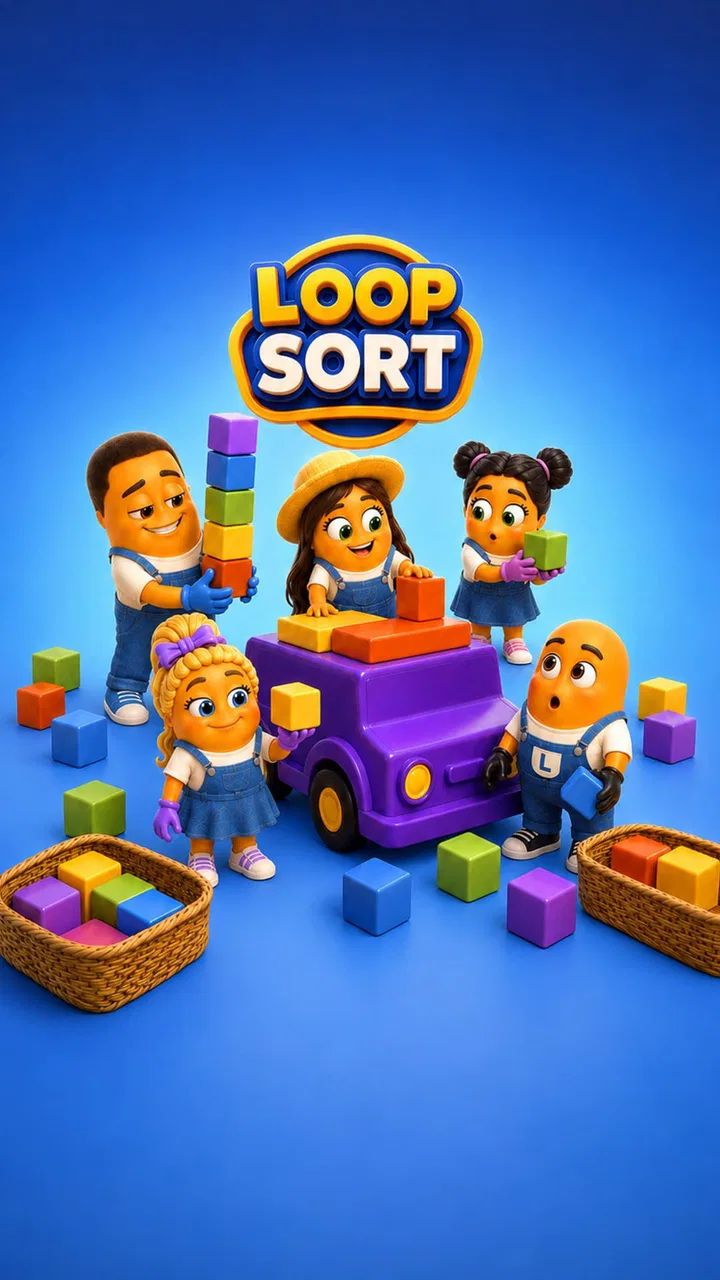
Loop Sort
- 4.5
- Rating
- 5.00M
- Installs
- Free
- Price
 Analysis by App-foxy
I went into Loop Sort expecting a quick sorting game and found something more deliberate than its one-tap presentation suggests. The idea is easy to understand: cubes leave a truck, move toward a conveyor, and need to be sorted through a repeating flow. That simple setup makes it approachable immediately, but the real question is whether you enjoy planning a sequence while the board gradually becomes less forgiving.
This is a free puzzle game from VOODOO, aimed at players who like short sessions rather than a long story or a complicated collection of systems. It has a Teen content rating and runs on devices using Android 8.0 or later. The current release is version 2.13.0, and the game has already passed one million installs, with a 4.7 average from roughly fourteen thousand ratings. Those figures suggest that its basic loop connects with a broad audience, although popularity alone does not tell me whether it will suit your preferred puzzle style.
What to consider before choosing it
Before choosing it, I’d ask whether a focused sorting loop is something I’ll return to once the first few sessions feel familiar. I’d also consider how I usually use puzzle games: as a brief reset between tasks, or as a deeper activity I expect to hold my attention for longer stretches. That distinction helps set realistic expectations for its staying power.
You May Also Like

 Blood Strike: 2.5 Anniversary
Blood Strike’s Loadouts Turn Every Drop Into a Tactical Gamble
A close look at Blood Strike’s custom loadouts: how fast access to signature weapons reshapes its battle royale rhythm, rewards preparation, and narrows the gap between fights.

 Pandora - Music & Podcasts
Pandora’s Music Is Easy to Start, but Harder to Recover
Pandora’s strength is its low-effort path from a seed to a station. Its weak spot is how much confidence it asks you to place in connection, setup, and quiet recovery.

 8 Ball Pool
 Is Built on Rivalries, Rematches, and Routine
A close look at the rivalries, rematches, shared routines, and unanswered safety questions that turn a quick pool match into a persistent mobile community.

 Samsung Music
’s Quiet Strength Is Playing What You Already Own
Its reach comes less from spectacle than from dependable access to a personal library. That simplicity is both the app’s strongest retention engine and its ceiling.

 AccuWeather: Weather Radar
AccuWeather Review: A Quick, Clear Forecast for Everyday Decisions
For everyday plans, the best forecast is the one you can understand quickly. AccuWeather makes rain timing, radar, and local conditions easy to act on, with a few trade-offs.

 Hill Climb Racing
Why Hill Climb Racing Still Turns Crashes Into One More Run
A tiny car, a bumpy hill and one more upgrade: Hill Climb Racing keeps resurfacing because its simple chaos makes every near-miss feel personal.
More From Our News Desk



The central decision is about pressure, not complexity
The most important thing to decide is whether you want a puzzle that teaches itself in seconds but still asks you to think ahead. Loop Sort does not appear to depend on a large rulebook. You watch the cubes, identify the useful order, and make taps that keep the sorting process moving. That makes it a comfortable choice when I want something I can start without reading instructions or learning a character system.
At the same time, “simple controls” should not be confused with “no decisions.” A tap can affect the next part of the conveyor’s flow, so acting quickly without checking what follows can leave the arrangement worse than it was. I found the best mindset was to pause mentally before each move, especially when several colors or cube groups compete for the same space. The game rewards a small amount of planning more than constant tapping.
That distinction matters when comparing it with other puzzle games. If you normally play word puzzles, match-three games, or number grids, you may be used to finding a pattern that stays visible on the board. Here, the conveyor gives the puzzle a sense of movement. I was not only asking, “Where does this cube belong?” I was also asking, “What will this choice make possible on the next pass?” The loop is the identity of the game, not merely a visual theme.
A practical test for your own play style
I would recommend trying it if you enjoy puzzles that fit naturally into small gaps in the day. A short break, a waiting room, or the few minutes before bed is enough to make progress without committing to a long play session. The free entry point also makes that experiment easy. You can see whether the timing and sorting rhythm feel satisfying before deciding whether it deserves a permanent place on your phone.
I would be more cautious if you need deep variety from every session. The core activity remains sorting cubes through the truck-and-conveyor setup. Players who want exploration, narrative objectives, elaborate character upgrades, or a wide range of puzzle rule sets may find the experience narrow. Its strength is focus, and focus can feel repetitive when you are looking for a broader game.
How I approach a difficult arrangement
My most useful habit was to avoid spending the first tap immediately. I looked for the color or group that could create the most room, then considered whether moving it would block a more urgent route. This is a small change, but it turns the game from reflexive tapping into a compact planning exercise. When the board became crowded, I treated open space as a resource rather than assuming that the next obvious cube was automatically the correct choice.
Another helpful approach is to think in short sequences instead of trying to solve everything at once. I would identify a safe move, watch how the conveyor changed, and then reassess. That method is less dramatic than guessing a complete solution, but it reduces the chance of building a problem several moves ahead. It also makes the game more comfortable on a phone, where a brief interruption can break concentration.
There is a trade-off here. Careful planning can make the game feel calmer and more logical, but it may also slow down a session that is designed to feel quick. If you enjoy fast reactions, you might prefer to act on instinct and accept occasional mistakes. If you enjoy clean solutions, taking a moment to inspect the flow is usually more rewarding.
Where the game wins against familiar puzzle alternatives
Loop Sort’s clearest advantage is its low barrier to entry. A traditional logic puzzle may require you to understand a grid, a numerical rule, or a set of symbols before the challenge becomes enjoyable. This game communicates more through movement and color grouping. I could understand the immediate goal without needing a long explanation, which makes it friendlier for casual players and for people who do not normally describe themselves as puzzle fans.
It also has a useful middle ground between passive matching and demanding brainteasers. Match-style games often make the next move visually obvious, while harder logic games can require sustained concentration from the beginning. The conveyor format sits between those experiences. The visual action keeps the game lively, but the repeated flow gives you enough structure to plan rather than simply react.
That makes it particularly suitable for someone who wants a puzzle with a physical sense of progress. Watching cubes move into a better arrangement is more tangible than filling in an abstract answer. I liked that each decision seemed connected to the board’s movement, because the result was easy to read. When a choice worked, the improvement was visible rather than hidden behind a score screen.
Another strength is how naturally the game supports a “one more attempt” habit. A failed sequence does not require me to rebuild a complicated strategy from memory. I can look at the arrangement again and change the point where the flow went wrong. That makes experimentation less intimidating than in puzzles where one early error ruins a long chain of deductions.
Where a different kind of puzzle may fit better
The same simplicity that helps newcomers can disappoint experienced puzzle players who want a large strategic vocabulary. If your ideal game offers many distinct mechanics, elaborate level objectives, or a campaign that constantly changes its rules, this is probably not the best match. I would choose a more systems-heavy puzzle for a long weekend session, especially when I want a sense of discovery rather than a focused sorting loop.
It may also be a weaker choice for players who dislike visual repetition. The truck, cubes, and conveyor define the experience so strongly that the game’s appeal depends on finding interest in their arrangement. Someone who wants a puzzle built around words, deduction clues, or story context will likely get more satisfaction elsewhere. That is not a flaw in the controls; it is a question of what kind of mental activity you find enjoyable.
There is also a difference between a game that is easy to start and one that is easy to master. The first few decisions may feel obvious, but later situations can punish careless ordering. If you are looking for a completely relaxing activity with no tension, the need to protect the flow may become irritating. In that case, a slower untimed puzzle or a creative sandbox would probably be a better fit.
What the free model means in everyday use
The game is free to download, which lowers the cost of trying it during a short break. It includes in-app purchases ranging from ninety-nine cents to ninety-nine dollars and ninety-nine cents per item. I would treat that range as a reason to decide your spending limit before playing for a long time, especially if you are installing it on a shared device or giving the phone to a younger player.
The free starting point is useful because this is a taste-sensitive game. You may enjoy the conveyor rhythm immediately, or you may know within a few sessions that sorting cubes is not enough variety for you. There is no need to commit to a larger puzzle collection before answering that basic question. For me, the sensible approach is to play it as a compact free option first and only consider purchases if they clearly improve the way I want to play.
I also recommend checking the purchase flow carefully before handing the device to someone else. The Teen rating does not make the game unsuitable for every younger player, but it does mean parents should make their own judgment. The rating and the presence of optional purchases are both useful reminders that “free” describes the entry price, not necessarily every possible way the game can be used.
The cost of switching from another puzzle game
Moving to Loop Sort from a familiar puzzle app is easy at the control level. You do not have to learn a complex interface or memorize a collection of special abilities. The bigger adjustment is mental: instead of searching for a static combination, you need to read the order in which cubes can move through the conveyor. Players who are comfortable thinking one or two steps ahead should adapt quickly.
The switching cost is higher if your current favorite gives constant rewards, story progression, or a large collection of modes. Loop Sort’s appeal comes from the puzzle action itself, so it may not replace a feature-rich game in your routine. I would use it alongside a deeper favorite rather than expecting it to become a complete substitute. It works well as the quick option in a two-game rotation.
One advantage of that arrangement is that the two experiences serve different moods. When I want a focused mental reset, I can sort a few arrangements without remembering a plot or managing a complicated inventory. When I want long-term progression, I would return to a larger puzzle game. Thinking of Loop Sort as a specialized tool rather than an all-purpose replacement gives a more accurate picture of its value.
Small habits that make the loop more satisfying
I found three habits especially useful. First, I checked the destination before tapping rather than following the cube that looked most noticeable. Second, I protected open space because a clear route can be more valuable than an immediate match. Third, after a mistake, I changed one decision at a time instead of restarting with a completely different strategy. These habits make the game feel more like problem solving and less like trial-and-error tapping.
A fourth habit is to stop when concentration drops. Because the sessions are naturally compact, there is little benefit in forcing a solution while distracted. A rushed tap can create a chain of awkward placements, and the frustration can make a simple puzzle feel unfair. Returning later with a fresh view often works better than repeatedly making the same hurried choice.
For a shared household device, I would also keep expectations clear: the game is easy to demonstrate, but the best solution may not be obvious to a new player. Showing someone how the cubes move is more helpful than telling them which tap to make. That preserves the puzzle and lets them discover the relationship between the truck, the conveyor, and the sorting order themselves.
Who should install it
I think Loop Sort is a good choice for casual puzzle players, commuters, and anyone who likes a clear objective with a little forward planning. It is especially appealing if you want to open a game quickly, understand the basic action without a tutorial marathon, and decide for yourself how carefully to play. The strong average rating and large install base show that the format has broad appeal, although your enjoyment will still depend on how much repetition you tolerate.
I would skip it if you need a story, competitive depth, elaborate progression, or a constant stream of radically different mechanics. I would also skip it if moving objects through a repeating conveyor does not sound satisfying on its own. No amount of polish can change the fact that the sorting loop is the main event. Choosing it makes sense only when that loop matches the kind of attention you want to give your phone.
My recommendation
Loop Sort earns my recommendation as a focused, free puzzle for short sessions. I like the way it turns a simple sorting task into a question of order, space, and timing without burying the player under unnecessary systems. The truck and conveyor give the game a distinct rhythm, while the one-tap interaction keeps the first few minutes welcoming.
My recommendation is more specific than “everyone should download it.” Install it if you want a compact alternative to word puzzles, match games, or heavier logic titles, and if you are happy for the central mechanic to carry most of the experience. Try it with a deliberate approach: inspect the flow, preserve room, and change one choice at a time when a sequence fails. If that process feels satisfying, the game can become a dependable little brain break.
If you are searching for a complete replacement for a deep puzzle favorite, I would look elsewhere or keep this as a secondary option. Its free price makes testing straightforward, but the optional purchases and Teen rating are worth keeping in mind for family devices. For my own phone, I see it as a clean recommendation for quick, tactile sorting puzzles—focused enough to learn instantly, but thoughtful enough that careless tapping does not always get me through.
FAQs for Loop Sort
01What is the main objective of Loop Sort?
Loop Sort is a captivating puzzle game where the main objective is to arrange a series of loops in the correct order. Each level presents a unique challenge, requiring strategic thinking and problem-solving skills to sort the loops efficiently. The game offers multiple levels, each increasing in complexity to keep players engaged.
02Is Loop Sort suitable for all age groups?
Yes, Loop Sort is designed to be accessible and enjoyable for players of all ages. Its intuitive interface and gradual difficulty progression make it suitable for children, while the more challenging levels provide an engaging experience for adults. It's a great way for families to enjoy a game together.
03Does Loop Sort require an internet connection to play?
Loop Sort can be played offline, making it a perfect option for those who want to enjoy the game without worrying about an internet connection. However, certain features, like leaderboards or in-game purchases, may require online access to function fully.
04Are there any in-app purchases in Loop Sort?
Yes, Loop Sort offers in-app purchases that provide enhancements such as additional levels or hints to help navigate more challenging puzzles. These purchases are entirely optional, and players can enjoy the core game experience without spending any money.
05What are the system requirements for Loop Sort on Android and iOS?
Loop Sort is optimized for both Android and iOS platforms. For Android, it requires version 5.0 (Lollipop) or higher, and for iOS, it needs iOS 10.0 or later. The game is lightweight, ensuring seamless performance on most modern devices with minimal storage usage.
Pros
- Intuitive drag-and-drop sorting.
- Visually appealing minimalist design.
- Variety of challenging levels.
- Offline play supported.
- Regular updates with new puzzles.
Cons
- Limited hints for difficult levels.
- Occasional ads interrupt gameplay.
- Some levels feel repetitive.
- No multiplayer or social features.
- Requires in-app purchases for extras.

Loop Sort
Gallery